06 · Cinematic symmetry
The Light Bar
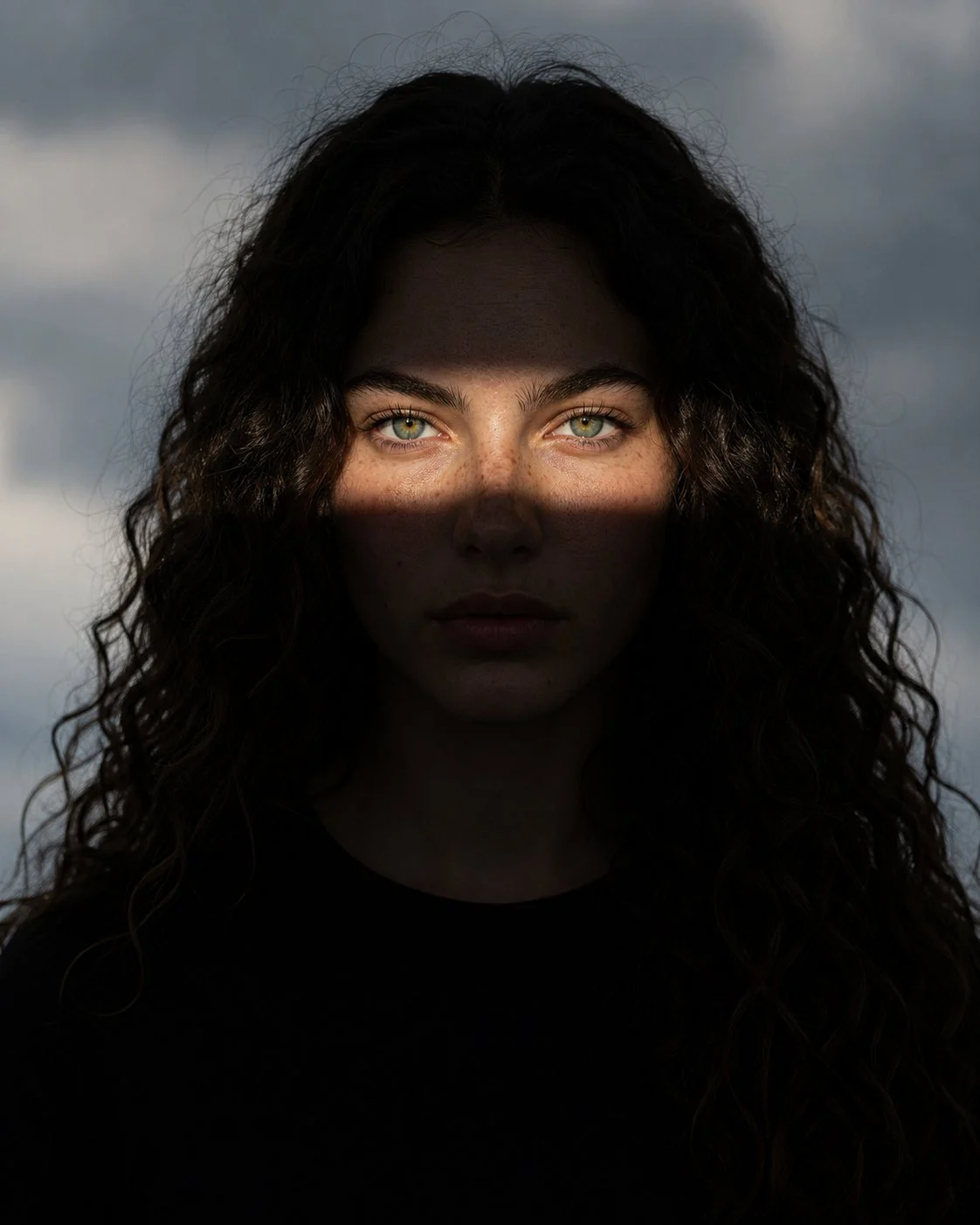
One narrow beam across the eyes and nothing else. Underexpose everything, expose for the strip, and let the frame do the rest.
- 4:5 vertical
- Single hard source
- Full camera spec
- Underexposed
Why it works
The instruction that makes this work is counter-intuitive: expose for the illuminated region, not the face. Generators default to a well-lit, evenly rendered subject because that is what most of their training data looks like. You have to actively spend words fighting that, hence the explicit ban on fill, rim, bounce and secondary sources, and the note that the shadow edge should be slightly irregular rather than a clean graphic band.
Swap these first
narrow horizontal beam across the eyes
vertical slash, blind-slat stripes, a thin diagonal
pale blue-grey overcast sky
black void, deep red wall, distant city bokeh
matte black crew-neck
white shirt for a much higher-contrast read
Create an ultra-photorealistic cinematic portrait of #SUBJECT attached in image 1.

The subject stands perfectly centred, facing directly toward the camera with a completely neutral expression.

COMPOSITION Vertical 4:5 portrait. Static camera. Eye-level viewpoint. Perfect bilateral symmetry. Head and shoulders composition. The subject occupies approximately 78-82% of the frame height. The top of the hair sits close to the upper edge while both shoulders remain visible near the lower corners. No tilt. No perspective distortion. No Dutch angle.

SUBJECT Replace #SUBJECT with the exact person attached while preserving every other characteristic of the image. The subject looks directly into the lens. Eyes remain perfectly level. Mouth closed. Relaxed facial muscles. No smile. No visible emotion. Natural realistic skin texture. No beauty retouching. No makeup unless specified by #SUBJECT. Hair follows the natural appearance of #SUBJECT. Wear a simple matte black crew-neck shirt with no logos, graphics, texture or branding.

LIGHTING - CRITICAL Single hard directional sunlight. The entire portrait is intentionally underexposed. Expose for the narrow illuminated region rather than the face. A very narrow horizontal beam of sunlight crosses only the eyes. The beam begins slightly above the eyebrows and finishes approximately halfway down the nose bridge. Both irises are fully illuminated. Both eyebrows receive partial illumination. The upper cheeks receive a slight amount of light. Everything above the beam falls into deep shadow. Everything below the beam falls into deep shadow. The nose, cheeks, jawline, mouth and neck remain almost completely black. Maintain a natural optical light transition. Do not create a perfectly straight graphic band. The edges of the shadow should be slightly irregular as though real sunlight is passing through a narrow opening. No fill light. No rim light. No bounce light. No secondary light source. No catchlights except those naturally created by the sunlight.

EXPOSURE High contrast. Deep blacks. Preserve highlight detail in the illuminated strip. Natural skin reflectance. No clipped whites. Minimal dynamic range compression. Rich shadow density.

BACKGROUND Simple overcast pale blue-grey sky. Soft cloud texture. Completely out of focus. No horizon. No buildings. No landscape. No trees. No objects. No gradients added in post.

COLOUR Muted cinematic grading. Cool blue-grey background. Neutral skin tones. Very restrained saturation. Natural white balance. No teal-orange grading. No excessive colour separation.

CAMERA Full-frame professional mirrorless camera. 85 mm portrait lens. f/4. ISO 100. 1/1600 s. Extremely sharp eyes. Natural depth of field. No artificial blur.

RENDERING True photorealism. Natural pores. Real facial texture. Subtle eyebrow hairs. Natural eyelashes. Fine hair detail. No CGI appearance. No stylisation. No painterly effects. No HDR look. No excessive sharpening. No skin smoothing. Editorial portrait photography quality. Ultra-high-resolution 8K.

NEGATIVE PROMPT No smile. No side lighting. No studio lighting. No softbox. No rim light. No lens flare. No glow. No bloom. No makeup enhancement. No beauty filter. No text. No watermark. No jewellery. No accessories. No hat. No logos. No facial distortion. No asymmetrical eyes. No exaggerated facial features. No low-resolution textures. No digital painting. No anime. No illustration. No stylisation. No additional people. No background objects.
The prompt is free to copy, change and use commercially, client work included, and whatever you generate with it is yours. Please do not resell the prompt text itself as a product, and do not reuse or redistribute the frame above: that one is my own character and stays mine.
What this is part of
The hard part was never writing the prompt.
It is the twenty minutes you lose every time you need one and start from a blank box. Then the second twenty, when you cannot find the version that worked last month. Then the third, explaining to someone else why their output does not match yours.
That is the problem I am building Nixra to solve. Not a bigger pile of prompts, but a place where the one you need is already tested, already labelled with the models it holds up on, and already parameterised so you can change the outfit without breaking the lighting.
These seven, the fifty style transfers, and the character-swap library are the beginning of what goes in it. On 28 August they stop being a page you read and become a shelf you pull from. The first fifty in get early access and a price locked for good.