03 · Monochrome documentary
The Paddock
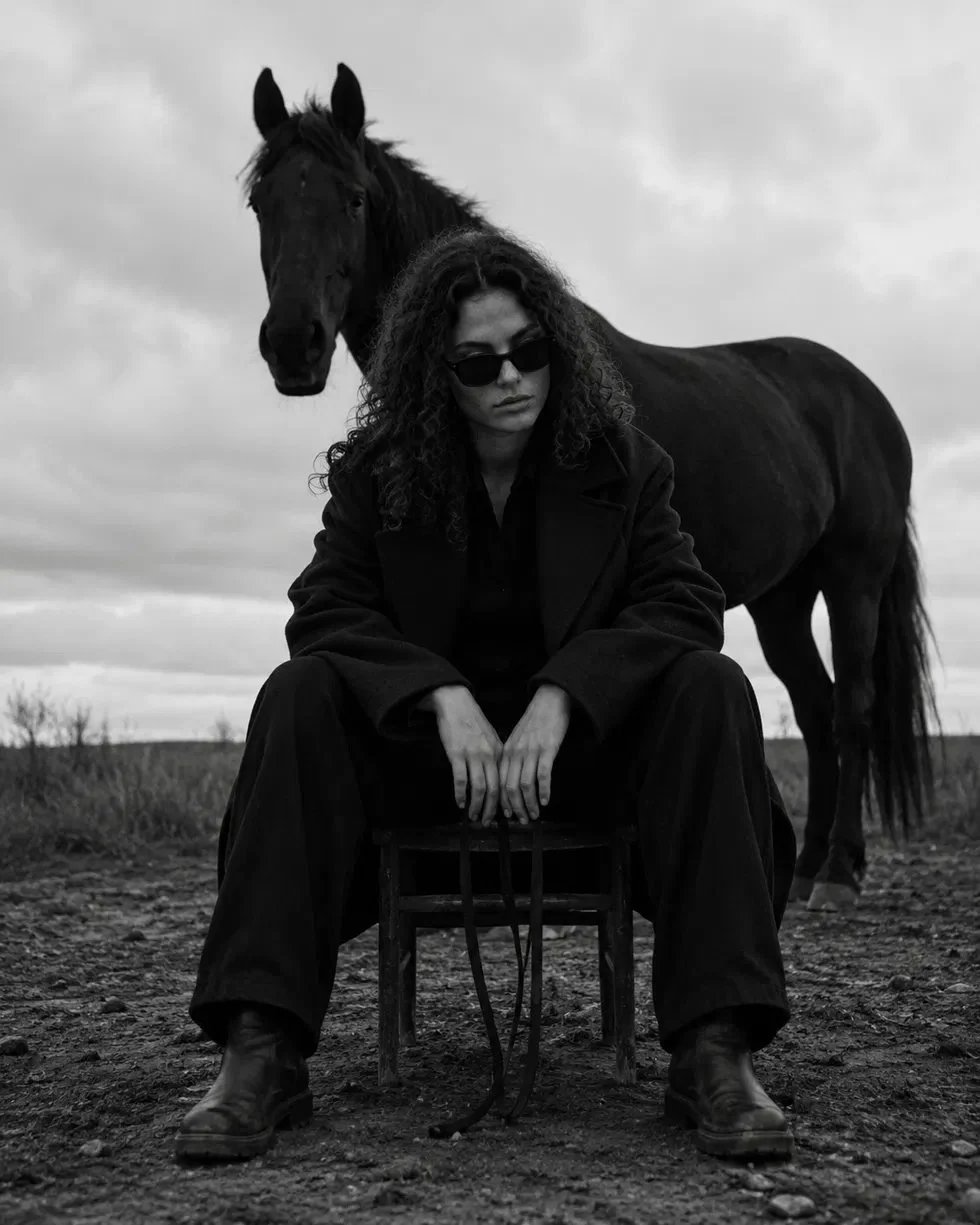
The most structurally demanding prompt in the set: a second living subject, a full seated body from boots to head, and a strict black-and-white exposure.
- 4:5 vertical
- Monochrome
- Named subject token
- Labelled blocks
Why it works
This one is built in labelled blocks: Scene, Composition, Pose, Wardrobe, Hands, Environment, Lighting, Camera, Treatment, Exclusions. That structure is not decoration. It gives the model a checklist rather than a paragraph to interpret, and it lets you swap one block without rewriting the prompt. The token #SUBJECT is repeated deliberately, because every repetition reinforces identity against drift.
Swap these first
large dark horse
a vintage motorcycle, a wolfhound, an empty second chair
bright overcast sky
dusk, heavy fog, hard midday sun for a harsher read
monochrome black-and-white
desaturated colour with a single warm accent
Create a vertical 4:5 ultra-photorealistic black-and-white cinematic editorial portrait using the attached character reference as #SUBJECT. Preserve #SUBJECT's exact facial structure, skin tone values, hair length, hair texture, hairstyle, body proportions, natural expression, and identity. Do not beautify, reshape, age-change, gender-change, or stylize #SUBJECT.

Scene: #SUBJECT sits alone on a simple low chair outdoors on rough dirt ground, centered in the frame. A large dark horse stands directly behind #SUBJECT, slightly offset to the left, with its head rising behind #SUBJECT's upper body and its body extending across the right side of the background. The horse is calm and still. The horse must appear real, full-sized, dark-coated, and naturally positioned behind the chair.

Composition: Vertical 4:5 frame. Low camera angle from slightly below #SUBJECT's seated eye level, positioned several feet in front of #SUBJECT. #SUBJECT occupies the central foreground from boots to head. Frame includes the full seated body: boots near the bottom edge, legs spread naturally, elbows resting on thighs, hands hanging together between the knees. The horse fills the background behind #SUBJECT, with its head visible over the left shoulder area and its torso and tail visible on the right side.

Pose: #SUBJECT sits slouched forward with a quiet, withdrawn posture. Head tilts slightly downward and slightly to one side. #SUBJECT does not smile. Expression is neutral, serious, detached, and introspective. #SUBJECT looks downward or toward the ground through dark sunglasses, not directly at the camera.

Wardrobe: #SUBJECT wears an oversized dark coat or heavy jacket with a loose collar and bulky sleeves. Underneath, #SUBJECT wears a dark top. #SUBJECT wears loose dark trousers with a wide relaxed fit, creating heavy folds around the knees and ankles. #SUBJECT wears sturdy dark leather boots with thick soles. Add dark sunglasses with a simple rectangular or slightly rounded shape. Do not add logos, bright accessories, jewelry, hats, scarves, or visible branding.

Hands / object: #SUBJECT's hands rest low between the knees. Fingers are relaxed and slightly interlaced or loosely overlapping. A thin dark strap, rein, or cord hangs vertically from the hands toward the ground, creating two narrow dark lines in front of the chair.

Environment: Outdoor rural field or paddock setting. The ground is uneven dirt and gravel with sparse grass along the edges. The background horizon is low. The sky is bright, overcast, and cloudy, creating a pale grey backdrop. No buildings, fences, cars, people, trees, signs, or modern objects are visible.

Lighting: Natural overcast daylight. High-contrast black-and-white exposure. The sky is bright and pale. #SUBJECT and horse are mostly dark, underexposed, and silhouette-heavy, but retain enough detail to see clothing folds, hair shape, sunglasses, hands, boots, horse head, mane, torso, and tail. Soft ambient light only. No hard sunlight, no studio lighting, no rim lights, no colored lighting.

Camera / lens: Cinematic editorial photograph, low-angle medium-wide portrait. Use a slightly wide lens around 35mm equivalent. Shallow-to-medium depth of field: #SUBJECT is the sharpest element, the horse remains recognizable with slight softness, and the distant ground and sky are softer. Natural lens falloff, realistic tonal compression, subtle film grain.

Image treatment: Monochrome black-and-white only. Deep blacks, muted midtones, pale grey sky, soft film grain, documentary fashion-editorial mood. Realistic skin texture, realistic fabric texture, natural hair detail, no artificial smoothing, no painterly effects, no CGI look.

Strict exclusions: Do not include carousel arrows, pagination dots, interface icons, social-media overlays, text, captions, watermarks, borders, frames, logos, or UI elements. Do not add extra people. Do not add more horses. Do not make the horse aggressive or moving. Do not place #SUBJECT standing. Do not crop out the boots. Do not brighten the outfit. Do not use color. Do not glamor-retouch the face. Do not alter #SUBJECT's identity.
The prompt is free to copy, change and use commercially, client work included, and whatever you generate with it is yours. Please do not resell the prompt text itself as a product, and do not reuse or redistribute the frame above: that one is my own character and stays mine.
What this is part of
The hard part was never writing the prompt.
It is the twenty minutes you lose every time you need one and start from a blank box. Then the second twenty, when you cannot find the version that worked last month. Then the third, explaining to someone else why their output does not match yours.
That is the problem I am building Nixra to solve. Not a bigger pile of prompts, but a place where the one you need is already tested, already labelled with the models it holds up on, and already parameterised so you can change the outfit without breaking the lighting.
These seven, the fifty style transfers, and the character-swap library are the beginning of what goes in it. On 28 August they stop being a page you read and become a shelf you pull from. The first fifty in get early access and a price locked for good.