07 · Interface render
The Product Hero
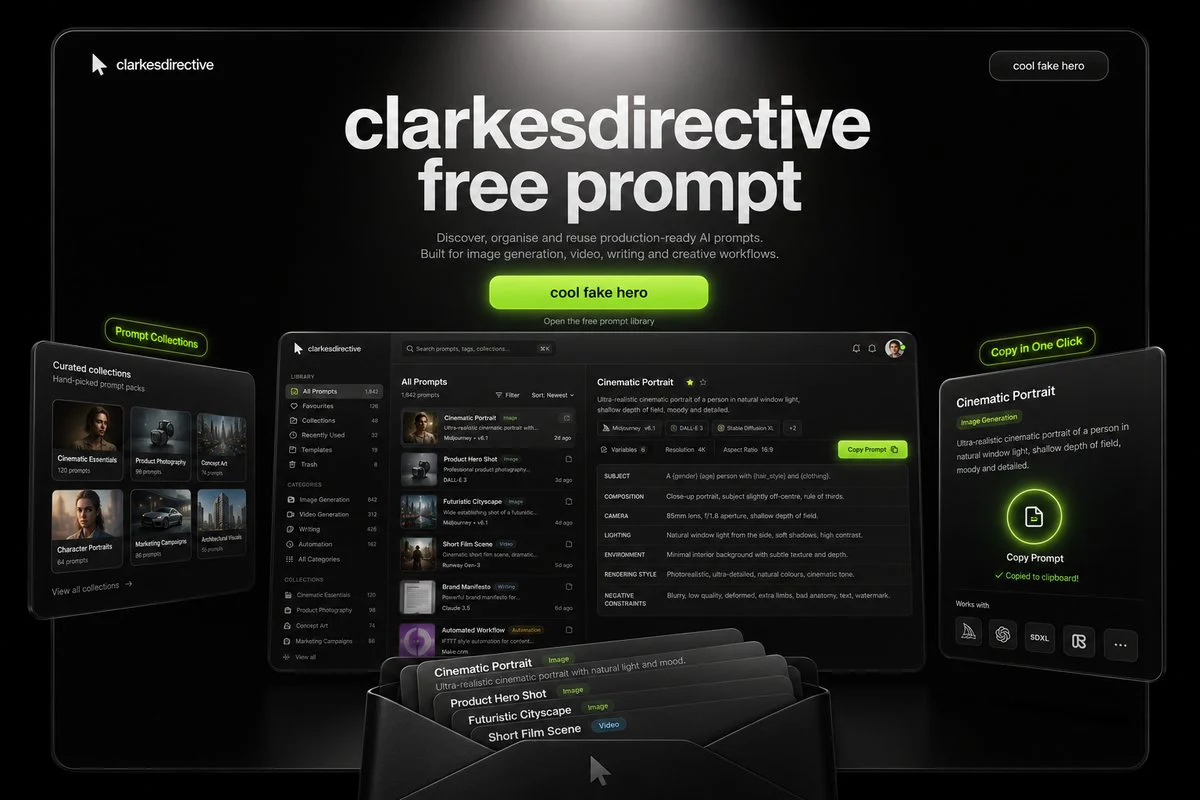
Proof the method travels. Same discipline, no human subject: an entire software landing page rendered as a single image.
- 3:2 landscape
- Interface
- Named regions
- No subject needed
Why it works
Identical architecture to the portraits, pointed at an interface instead of a face. Composition, lighting, colour, rendering, exclusions. The specificity is what keeps the type legible and the panels aligned: named regions, named UI elements, a named colour palette, and a closing lock that forbids the model from rearranging the layout it was just given.
Swap these first
neon lime-green accents
electric blue, warm amber, monochrome white
prompt library dashboard
analytics suite, CRM, video editor, booking platform
16:9 landscape
4:5 for social, 3:2 for a press kit
Ultra-premium AI prompt library SaaS landing page hero for a platform called {argument name="brand" default="your brand"}. Deep obsidian-black interface with cinematic spotlight lighting, floating glassmorphism UI panels, and luxury creative software aesthetics. Inspired by Apple product launches, Linear, Arc Browser, and high-end AI startup branding.

Use a perfectly centred and symmetrical composition with a large rounded-corner application frame floating on a pure black background. Maintain precise framing, visual hierarchy, object placement, symmetry, perspective, lighting structure, and spacing throughout.

Top-left: minimal monochrome directive-arrow or prompt-cursor logo beside the lowercase wordmark {argument name="brand" default="your brand"}. Top-right: floating glassmorphism button.

Hero section: massive oversized bold white typography centred. Typography is ultra-clean Swiss-style sans-serif with tight leading, monumental scale, and subtle light reflections passing across the letters. Below headline: small muted-grey supporting copy. Centred beneath: large glowing neon-green CTA button. Tiny microcopy underneath.

Lighting: a focused white spotlight descends from the top centre of the frame, creating a soft cone of illumination over the headline and CTA. The light gradually fades into darkness toward the edges, producing a luxury stage-like presentation.

Main showcase section: large floating AI prompt-library dashboard interface positioned below the CTA. Dashboard includes dark glassmorphism panels, a searchable prompt library, a large prompt-preview workspace, prompt title, description and category, folders and curated collections, image, video, writing and automation categories, model compatibility labels, variable and placeholder fields, a copy-prompt button, save and favourite controls, recently used prompts, a navigation sidebar, subtle green status indicators, soft internal shadows and premium creative-tool UI styling.

The central prompt editor displays a structured production-ready prompt with clearly separated sections such as: subject, composition, camera, lighting, environment, rendering style, negative constraints.

Foreground: large partially opened matte-black prompt card holder emerging from the bottom centre of the composition. Several layered prompt cards are visible inside it, creating a physical metaphor for a curated prompt archive while preserving the exact size, position, silhouette and foreground depth of the envelope element.

Left side: floating angled dashboard card emerging from darkness with a glowing pill label. The card displays a compact grid of curated prompt thumbnails, folders and category tags. Right side: floating angled dashboard card emerging from darkness with a glowing pill label. The card displays a selected prompt, a prominent copy icon and small model-format indicators. Side cards remain tilted in perspective and softly blurred to reinforce depth hierarchy.

Design language combines: Apple keynote aesthetics, cinematic SaaS presentation, premium AI prompt tooling, dark luxury minimalism, glassmorphism, Swiss typography, high-end creator software, structured prompt engineering, futuristic creative productivity, subtle cyber-minimalism.

Rendering style: front-facing website hero screenshot, ultra-clean alignment, realistic UI rendering, highly legible interface text, HDR bloom, soft volumetric spotlight, subtle film grain, ambient occlusion, realistic glass reflections, Octane Render-quality lighting.

Colour palette: obsidian black, graphite grey, soft white typography, muted charcoal, neon lime-green accents.

16:9 aspect ratio, ultra-premium prompt-library SaaS landing page render, photorealistic AI software marketing aesthetic, high-end Framer or Webflow showcase quality.

Do not change the composition. Do not move, remove or resize any major visual element. Only use the specified branding, copy, dashboard content, labels and foreground metaphor.
The prompt is free to copy, change and use commercially, client work included, and whatever you generate with it is yours. Please do not resell the prompt text itself as a product, and do not reuse or redistribute the frame above: that one is my own character and stays mine.
What this is part of
The hard part was never writing the prompt.
It is the twenty minutes you lose every time you need one and start from a blank box. Then the second twenty, when you cannot find the version that worked last month. Then the third, explaining to someone else why their output does not match yours.
That is the problem I am building Nixra to solve. Not a bigger pile of prompts, but a place where the one you need is already tested, already labelled with the models it holds up on, and already parameterised so you can change the outfit without breaking the lighting.
These seven, the fifty style transfers, and the character-swap library are the beginning of what goes in it. On 28 August they stop being a page you read and become a shelf you pull from. The first fifty in get early access and a price locked for good.