Free · No signup · Commercial use allowed

Seven prompts, and the reason each line is there.

Handpicked rather than scraped. Some I wrote, some I found and rebuilt until they held up twice in a row, and every one was adjusted to run on a placeholder rather than one fixed subject. That last part is the whole point: each of these is a character-swap template, so it runs on your face, not mine. Every frame beside them came out of GPT, on my account, using my own character. Nothing here is a mock-up, and nothing is behind an email.

Most prompts you find online are worth roughly what you paid for them. The problem is never the shortage. It is that you cannot tell which of the four hundred you just scrolled past was ever run to a finished frame, on which model, in which month.

So these come with the output attached. If a prompt is here, the image next to it is what came out.

Seven is what fits on one page. The style-transfer set runs to fifty more against a single source frame, and the character-swap set to a whole body of work built on one face. Every one of them is going into Transora as a template you run rather than text you paste, and that is what the first fifty get early access to on 28 August 2026.

What is yours, and what is not

Cost

Nothing, and there is no second step. No email, no trial, no gated download waiting further down the page.

The prompts are yours

Copy them, change them, run them commercially. Client work, your own brand, paid campaigns, and the images you generate from them are yours to sell. The only thing I ask is that you do not repackage the prompt text and sell it on as your own product.

The images are mine

Every frame on this page is my own character and my own output, and I am keeping those rights. They are here so you can see what each prompt actually does, not as stock. Please do not repost, redistribute or use them anywhere. Run the prompt on your own subject instead, and whatever comes out belongs to you.

What you need

All seven frames here were made in GPT. The prompts are not tied to it: they carry plain placeholders for the subject, so they run just as well in Midjourney, Nano Banana, Seedream, Flux Kontext or Stable Diffusion XL. None of them require a reference image. Attaching one simply gives the model a face to hold on to, which is what keeps the same person turning up frame after frame.

Before you paste anything

Six rules that separate a prompt from a paragraph.

Read these once and every prompt below will make more sense, including the ones you write yourself afterwards.

  1. 01

    If you attach a reference, it is most of the result

    None of these need one, but a reference is the difference between a person and the same person twice. If you use one: soft light, both eyes visible, no heavy makeup, no sunglasses, no extreme angle, no filter. A generator can only preserve what it can actually see, and a bad reference cannot be rescued by a better prompt. It can only be described around.

  2. 02

    Name the things you want kept

    “Preserve identity” does almost nothing. “Preserve hair length, texture, colour, shape and natural placement” does a great deal. Drift happens in the attributes you forgot to mention, so mention them: face shape, skin texture, asymmetry, hairline, proportions, age. Repetition is not redundancy here. Each restatement pulls the output back.

  3. 03

    Write in blocks, not prose

    Scene. Composition. Pose. Wardrobe. Lighting. Camera. Treatment. Exclusions. A labelled block is a checklist the model can satisfy one item at a time, and it lets you replace a single section later without rewriting anything else.

  4. 04

    Spend your words on light

    Direction, quality, hardness, colour temperature, what it does when it lands. “Warm golden-hour sunlight from camera left, diffused through linen, wrapping without harsh contrast” is worth more than any number of words like stunning, beautiful or masterpiece. Amateur prompts describe the subject. Professional prompts describe the photograph.

  5. 05

    Negative constraints are load-bearing

    Models default to the average of their training data: flattering light, symmetrical beauty, cluttered backgrounds, a faint smile. If you want none of that, you have to spend words removing it. Notice how much of The Light Bar is devoted to forbidding fill light. That is not padding, it is the entire shot.

  6. 06

    Change one thing at a time

    When a generation goes wrong the instinct is to rewrite everything. Do not. Change one block, regenerate, compare. You will learn which lines are actually carrying weight in about twenty minutes, and that knowledge transfers to every prompt you touch afterwards.

The set

Seven prompts. Seven finished frames.

Prompt text is selectable and copies in one click. Every one carries a placeholder where the subject goes, which makes each of these a character-swap template: point it at your own reference and the frame rebuilds around them.

01Editorial close-up

The Linen Veil

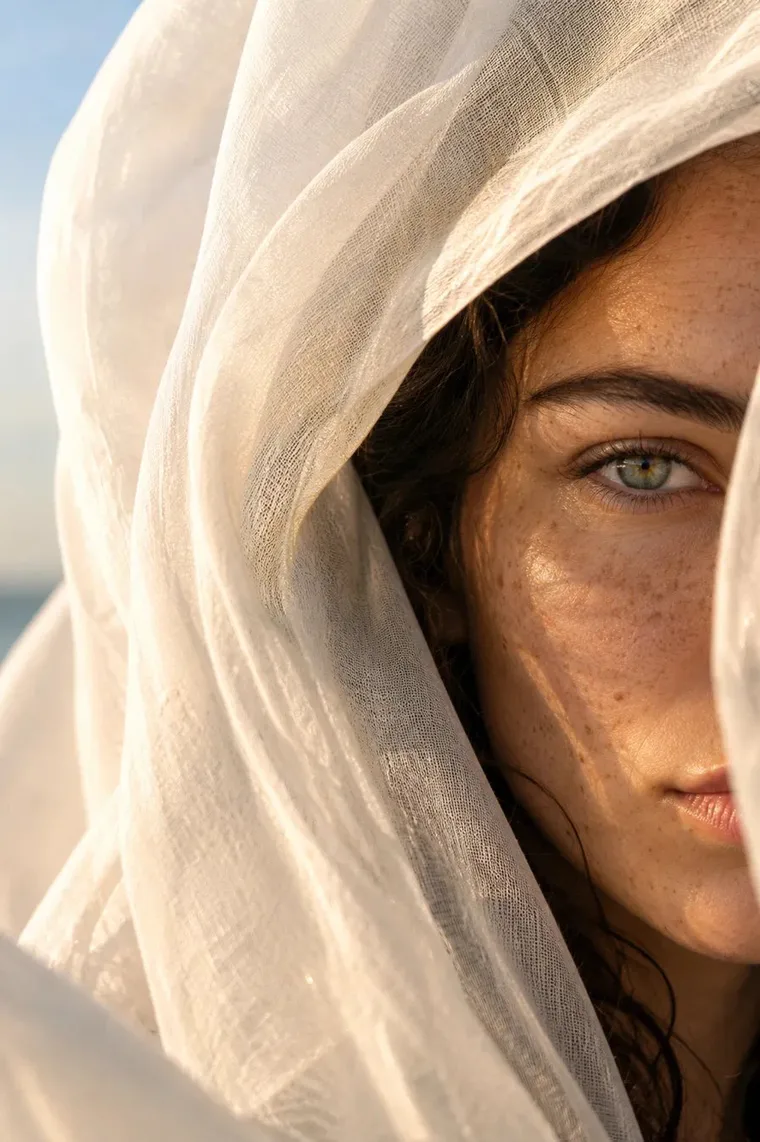
A concealment shot. Half the face is hidden, so the half you can see carries everything, and the model stops trying to average out a whole face.

  • 2:3 vertical
  • Golden hour
  • Occlusion
  • Close-up
Read the prompt

Why it works

Occlusion is the cheapest realism trick there is. Every generator gets weaker the more of a face it has to resolve at once. Hide half of it behind fabric and you halve the surface area where identity drift can happen. The veil also gives the light something to do, diffusing, wrapping and casting fibre shadow, which is what separates a photograph from a render.

Swap these first

sheer white linen

black tulle, wet silk, mosquito netting, a shower screen

golden-hour sunlight from camera left

blue hour, overcast north light, a single hard window

soft coastal tones of pale blue and warm cream

deep terracotta, charcoal studio, dense green foliage

The prompt

Ultra-photorealistic high-fashion editorial portrait of the exact subject attached partially concealed behind a sheer white linen veil. The veil wraps loosely around the subject's head and face, creating several overlapping translucent folds that naturally frame the composition. Only the right half of the face is visible through an opening in the fabric. One eye is sharply in focus while the other eye remains completely hidden. The lower portion of the face reveals only the right side of the lips and cheek. The expression is neutral and relaxed.

Warm golden-hour sunlight enters from camera left, passing through the linen and creating soft diffusion, gentle shadows, and subtle highlights across the skin. The linen texture remains clearly visible with realistic woven fibers and natural translucency. Light softly wraps around the face without harsh contrast.

The background is completely out of focus with soft coastal tones of pale blue and warm cream, suggesting an outdoor seaside location. Background blur is smooth and unobtrusive.

Camera positioned extremely close to the subject, filling nearly the entire frame with the face and linen. The veil itself occupies much of the foreground, producing soft foreground blur and layered depth.

Luxury fashion campaign photography. Minimalist composition. Editorial magazine quality. Authentic skin rendering. Cinematic natural light. Hyperrealistic. 8K RAW photograph.

02Environmental portrait

The Windswept Field

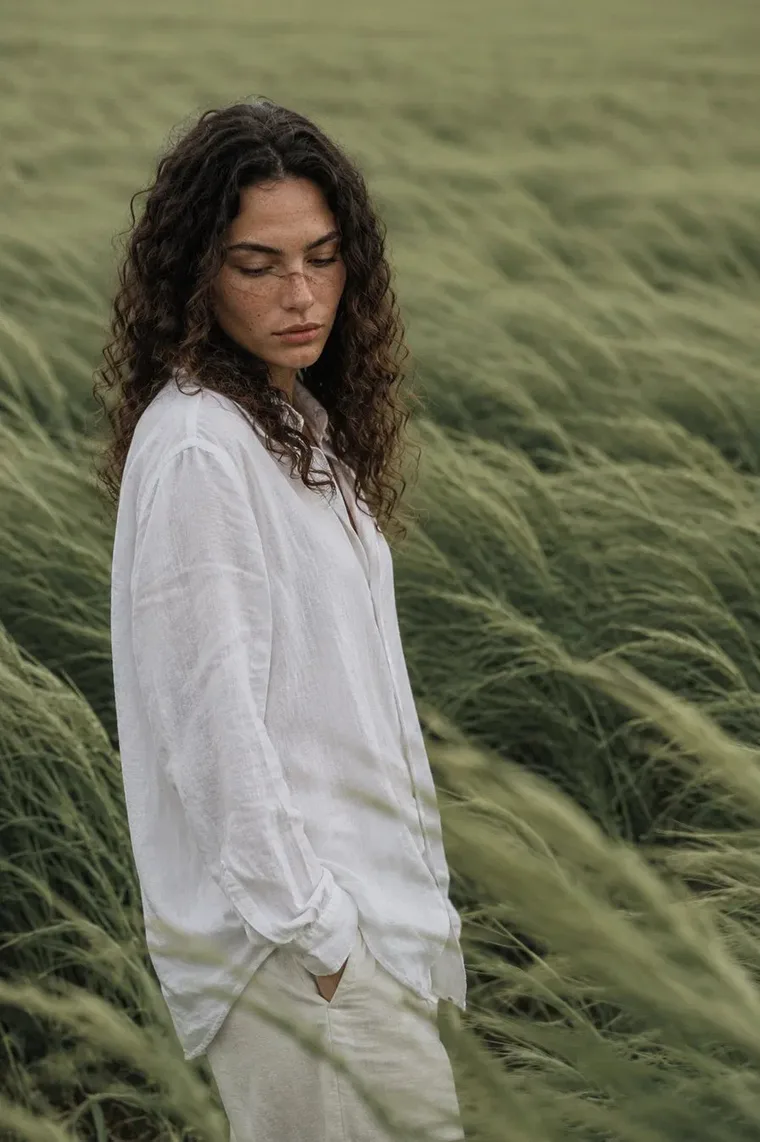
Negative space as a status signal. The subject sits in the left third and the rest of the frame is weather. Reads as campaign, not as snapshot.

  • 2:3 vertical
  • Overcast daylight
  • Negative space
  • Exclusion list
Read the prompt

Why it works

Two instructions are doing the heavy lifting: the hair lock and the exclusion list. Naming hair length, texture, colour, shape and placement stops the quiet substitution that ruins most likeness work. Banning trees, buildings, roads, flowers and fences stops the model filling empty space with clutter it assumes you want.

Swap these first

tall windswept green grass

wheat, lavender rows, dune grass, a snow field, wet sand

oversized white linen button-up shirt

heavy knit, trench coat, tailored black suit

subject occupies the left third

right third, or dead centre for a colder, more formal read

The prompt

Ultra-photorealistic cinematic editorial portrait of the exact subject attached (no alterations) standing alone in a vast field of tall, windswept green grass. They're shown from approximately mid-thigh upward in a vertical composition. The body faces left in profile while the head tilts slightly downward, eyes lowered, with a calm, introspective, neutral expression. They're not looking at the camera.

Their hair keeps the exact same length, texture, colour, shape, and natural placement as the attached reference image. Several slightly wind-touched strands fall naturally across the forehead and around the face where appropriate. The hair has natural volume and movement from the wind.

They wear a relaxed oversized white linen button-up shirt with a soft collar, long sleeves, lightweight fabric, subtle wrinkles, and an untucked fit. No accessories, jewellery, or visible logos.

The surrounding landscape consists entirely of dense, waist-high wild grass extending uninterrupted to the horizon. Strong wind bends the grass into flowing directional patterns, creating visible movement throughout the frame. The grass in the foreground is slightly closer to the camera and softly blurred, while the subject remains sharply in focus.

The lighting is soft natural overcast daylight with no direct sunlight. The colour palette is muted and restrained, dominated by cool greens, soft whites, and natural skin tones. Contrast remains low with gentle tonal transitions and subtle atmospheric softness.

The background consists only of the continuous grassy field with no trees, buildings, roads, flowers, fences, mountains, or sky distractions beyond a softly blurred distant field. The depth of field is shallow enough to isolate the subject while preserving the recognizable texture of the surrounding grass.

Camera positioned at approximately chest height, using a medium telephoto perspective. The subject occupies the left third of the frame with generous negative space surrounding them. The image is composed as a luxury fashion editorial photograph with authentic skin texture, natural fabric detail, realistic hair strands, cinematic realism, understated colour grading, and true-to-life photographic rendering. Ultra-photorealistic, 8K RAW.

03Monochrome documentary

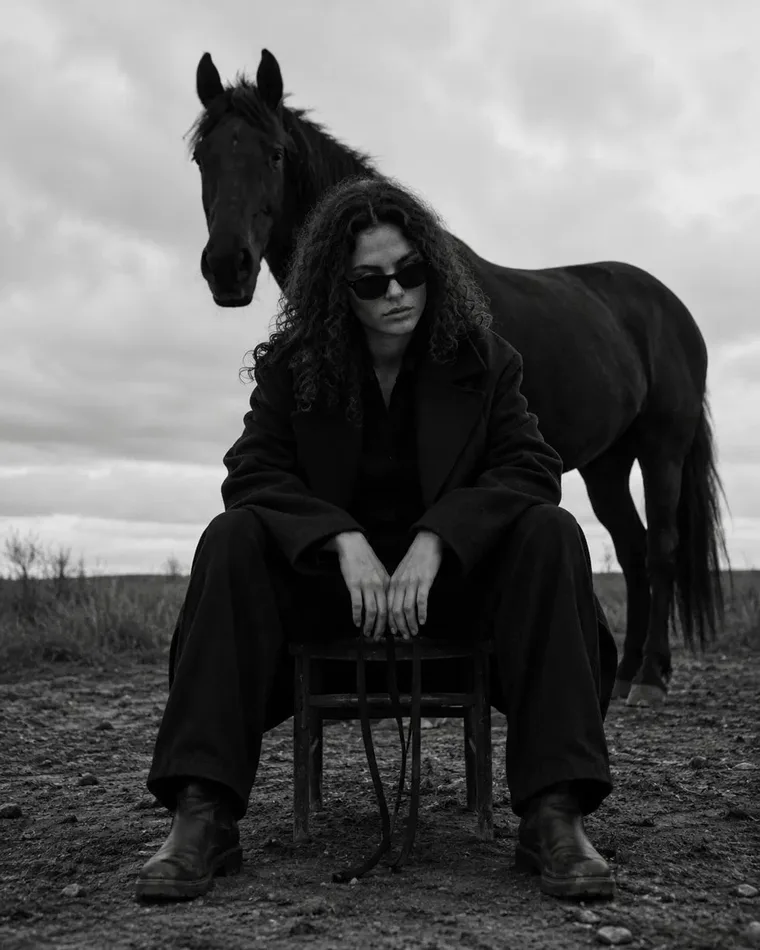
The Paddock

The most structurally demanding prompt in the set: a second living subject, a full seated body from boots to head, and a strict black-and-white exposure.

  • 4:5 vertical
  • Monochrome
  • Named subject token
  • Labelled blocks
Read the prompt

Why it works

This one is built in labelled blocks: Scene, Composition, Pose, Wardrobe, Hands, Environment, Lighting, Camera, Treatment, Exclusions. That structure is not decoration. It gives the model a checklist rather than a paragraph to interpret, and it lets you swap one block without rewriting the prompt. The token #SUBJECT is repeated deliberately, because every repetition reinforces identity against drift.

Swap these first

large dark horse

a vintage motorcycle, a wolfhound, an empty second chair

bright overcast sky

dusk, heavy fog, hard midday sun for a harsher read

monochrome black-and-white

desaturated colour with a single warm accent

The prompt

Create a vertical 4:5 ultra-photorealistic black-and-white cinematic editorial portrait using the attached character reference as #SUBJECT. Preserve #SUBJECT's exact facial structure, skin tone values, hair length, hair texture, hairstyle, body proportions, natural expression, and identity. Do not beautify, reshape, age-change, gender-change, or stylize #SUBJECT.

Scene: #SUBJECT sits alone on a simple low chair outdoors on rough dirt ground, centered in the frame. A large dark horse stands directly behind #SUBJECT, slightly offset to the left, with its head rising behind #SUBJECT's upper body and its body extending across the right side of the background. The horse is calm and still. The horse must appear real, full-sized, dark-coated, and naturally positioned behind the chair.

Composition: Vertical 4:5 frame. Low camera angle from slightly below #SUBJECT's seated eye level, positioned several feet in front of #SUBJECT. #SUBJECT occupies the central foreground from boots to head. Frame includes the full seated body: boots near the bottom edge, legs spread naturally, elbows resting on thighs, hands hanging together between the knees. The horse fills the background behind #SUBJECT, with its head visible over the left shoulder area and its torso and tail visible on the right side.

Pose: #SUBJECT sits slouched forward with a quiet, withdrawn posture. Head tilts slightly downward and slightly to one side. #SUBJECT does not smile. Expression is neutral, serious, detached, and introspective. #SUBJECT looks downward or toward the ground through dark sunglasses, not directly at the camera.

Wardrobe: #SUBJECT wears an oversized dark coat or heavy jacket with a loose collar and bulky sleeves. Underneath, #SUBJECT wears a dark top. #SUBJECT wears loose dark trousers with a wide relaxed fit, creating heavy folds around the knees and ankles. #SUBJECT wears sturdy dark leather boots with thick soles. Add dark sunglasses with a simple rectangular or slightly rounded shape. Do not add logos, bright accessories, jewelry, hats, scarves, or visible branding.

Hands / object: #SUBJECT's hands rest low between the knees. Fingers are relaxed and slightly interlaced or loosely overlapping. A thin dark strap, rein, or cord hangs vertically from the hands toward the ground, creating two narrow dark lines in front of the chair.

Environment: Outdoor rural field or paddock setting. The ground is uneven dirt and gravel with sparse grass along the edges. The background horizon is low. The sky is bright, overcast, and cloudy, creating a pale grey backdrop. No buildings, fences, cars, people, trees, signs, or modern objects are visible.

Lighting: Natural overcast daylight. High-contrast black-and-white exposure. The sky is bright and pale. #SUBJECT and horse are mostly dark, underexposed, and silhouette-heavy, but retain enough detail to see clothing folds, hair shape, sunglasses, hands, boots, horse head, mane, torso, and tail. Soft ambient light only. No hard sunlight, no studio lighting, no rim lights, no colored lighting.

Camera / lens: Cinematic editorial photograph, low-angle medium-wide portrait. Use a slightly wide lens around 35mm equivalent. Shallow-to-medium depth of field: #SUBJECT is the sharpest element, the horse remains recognizable with slight softness, and the distant ground and sky are softer. Natural lens falloff, realistic tonal compression, subtle film grain.

Image treatment: Monochrome black-and-white only. Deep blacks, muted midtones, pale grey sky, soft film grain, documentary fashion-editorial mood. Realistic skin texture, realistic fabric texture, natural hair detail, no artificial smoothing, no painterly effects, no CGI look.

Strict exclusions: Do not include carousel arrows, pagination dots, interface icons, social-media overlays, text, captions, watermarks, borders, frames, logos, or UI elements. Do not add extra people. Do not add more horses. Do not make the horse aggressive or moving. Do not place #SUBJECT standing. Do not crop out the boots. Do not brighten the outfit. Do not use color. Do not glamor-retouch the face. Do not alter #SUBJECT's identity.

04Natural-light portrait

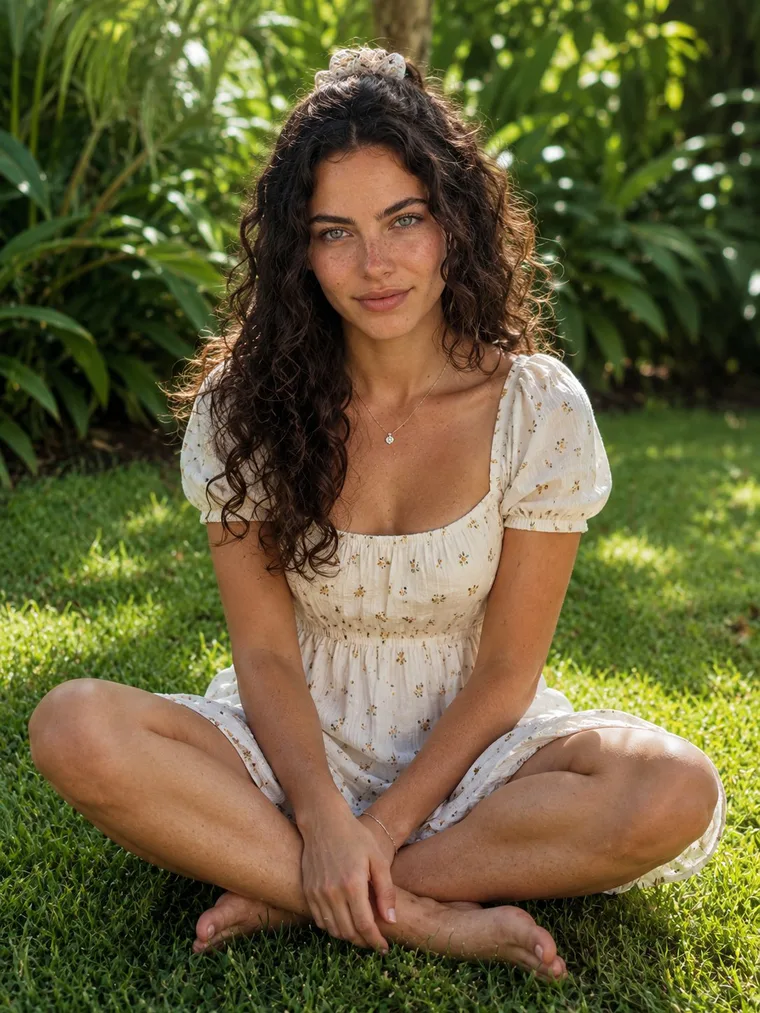
The Garden, 85mm

The commercial workhorse. Warm, approachable, unmistakably a photograph, and written with variable fields so one prompt becomes a hundred.

  • 3:4 vertical
  • Variable fields
  • Dappled daylight
  • Anatomy guards
Read the prompt

Why it works

Look at the two brace-wrapped fields. Those are variables. Swap the value and the entire wardrobe or styling changes while every identity lock, lighting instruction and anatomy guard stays intact. That is how a single prompt becomes a repeatable shoot. The closing negative block is also unusually long, and deliberately so, because hands, feet and fabric are where photoreal portraits fail.

Swap these first

accessory: white lace scrunchie

silk headscarf, tortoiseshell claw clip, nothing at all

outfit: delicate white midi dress

linen jumpsuit, cream knit and jeans, black slip dress

sunlit tropical garden

olive grove, walled English garden, rooftop at golden hour

The prompt

Create a photorealistic 3:4 outdoor portrait of the adult subject shown in the attached reference image, sitting cross-legged on lush green grass in a bright, peaceful garden. Preserve the subject's exact identity, recognizable facial structure, proportions, skin tone, age, ethnicity, facial features, and overall likeness from the reference image. Do not reinterpret, beautify, feminize, masculinize, age-shift, or otherwise alter the subject's identity.

The camera is positioned naturally in front of the subject at approximately seated eye level, using the perspective and compression of an 85mm portrait lens. Frame the subject from slightly above the top of the hair to around the lower legs or ankles, allowing the crossed-leg pose and surrounding garden to remain clearly visible. Keep the subject as the visual focus, with a softly blurred natural background and realistic shallow depth of field.

The subject sits comfortably cross-legged on fresh green grass with relaxed posture and natural body proportions. The shoulders, arms, hands, legs, and feet should appear anatomically correct and casually positioned. The subject is barefoot.

Preserve the subject's natural face shape, skin tone, eyebrows, eye shape and colour, eyelashes, nose, lips, jawline, ears, and all other distinguishing facial characteristics exactly as shown in the attached reference image. Maintain realistic facial asymmetry and natural skin texture. The subject looks toward the camera with a gentle closed-mouth smile and a calm, approachable expression.

Preserve the subject's natural hair colour, texture, density, hairline, length, and general characteristics from the attached reference image. Style the hair loosely and naturally, partially gathered back with a {argument name="accessory" default="white lace scrunchie"} while allowing the remaining hair to fall naturally around the head and shoulders. The accessory should adapt naturally to the subject's actual hairstyle and hair length rather than forcing an incompatible hairstyle.

Dress the subject in a {argument name="outfit" default="delicate white midi dress"} with short softly puffed sleeves, a square neckline, lightly textured flowing fabric, and scattered tiny yellow-and-brown floral prints. Adapt the garment naturally to the subject's body shape and proportions while preserving realistic fabric construction, folds, seams, weight, and drape. The dress should flow softly around the seated pose without distorted fabric or unnatural clipping.

Add understated accessories: a fine silver necklace with a small pendant and a matching delicate bracelet. Keep jewellery proportionate, physically plausible, and secondary to the subject.

Use soft natural makeup only where appropriate to the reference subject, preserving their recognizable appearance rather than changing facial structure or skin character. Do not force makeup, grooming, or gender-coded styling that conflicts with the uploaded subject.

The environment is a sunlit tropical or subtropical garden with dense green plants, layered foliage, fresh grass, and softly illuminated leaves in the background. Warm daylight filters through overhead foliage, creating subtle dappled sunlight across the grass, clothing, hair, and parts of the subject while avoiding harsh patches across the face. Background highlights should feel naturally photographic rather than artificially glowing.

Use realistic natural outdoor lighting with soft directional daylight, gentle shadow transitions, believable reflected green light from the surrounding foliage, accurate skin tones, and restrained highlight roll-off. Keep the face clearly exposed and visually dominant.

Photorealistic professional portrait photography, 85mm lens character, shallow depth of field, realistic optical bokeh, highly detailed natural skin texture, individual hair strands, accurate hands and feet, fine fabric texture, believable jewellery reflections, realistic grass and foliage, subtle photographic imperfections, natural colour reproduction, and lifelike dynamic range.

The final image should feel like a genuine portrait photograph of the exact uploaded person in this garden scene, not a generic model inspired by them.

No identity drift, no face replacement, no altered ethnicity, no altered age, no altered facial proportions, no forced gender presentation, no incompatible hairstyle, no excessive beauty filtering, no plastic skin, no over-smoothed face, no exaggerated makeup, no warped anatomy, no extra fingers, no missing fingers, no fused hands, no malformed feet, no duplicated limbs, no distorted dress, no artificial-looking foliage, no extreme HDR, no oversaturation, no anime, no illustration, no CGI appearance, no text, no logo, no watermark.
05Casual intimacy

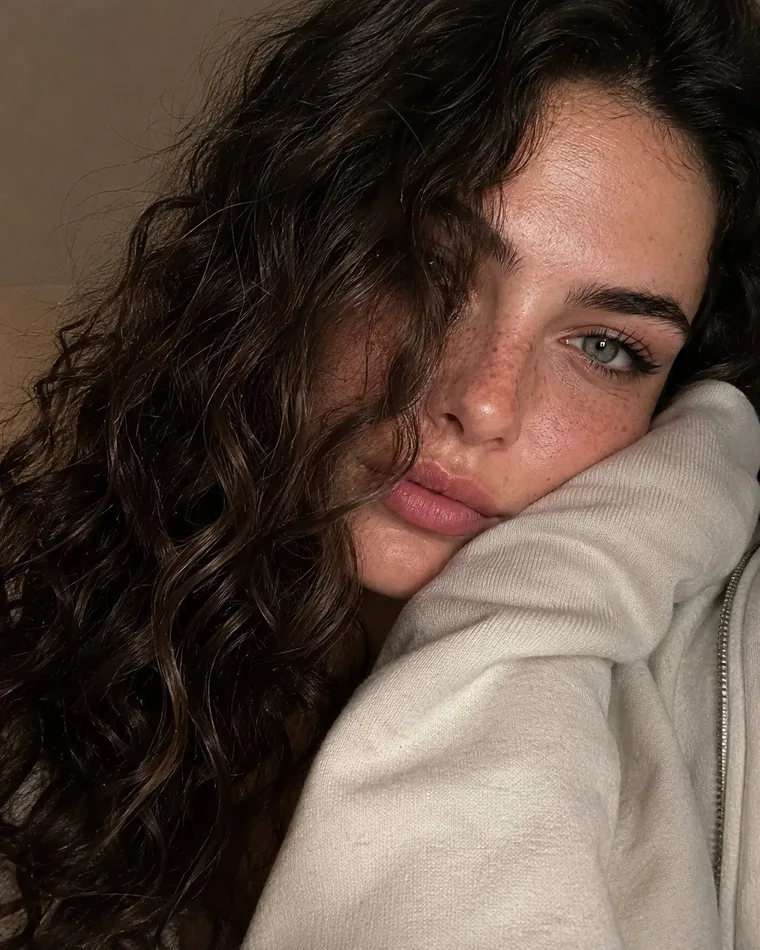
The Webcam Selfie

Deliberately imperfect. A slight frame tilt, front-left screen light and a face too close to the lens, which is the grammar of a real photo taken by the person in it.

  • 4:5 vertical
  • Bracketed tokens
  • Warm indoor light
  • Deliberate imperfection
Read the prompt

Why it works

Most prompts fail by asking for perfection. This one asks for the artefacts of an actual camera phone: the tilt, the closeness, the flat frontal light of a screen. It also uses bracketed tokens as instructions to the model rather than as content, which is a lighter-touch alternative to the hash token system in The Paddock and easier to hand to a client.

Swap these first

cream-coloured hoodie

grey marl crewneck, oversized denim jacket, white bath towel

warm gray-beige wall

cluttered bedroom, car interior at night, cafe window

winged eyeliner and dusty-pink lips

bare skin, smudged liner, high-gloss editorial makeup

The prompt

A photorealistic close-up portrait of [UPLOADED SUBJECT] filling almost the entire frame. Their head is slightly tilted to the side, with their cheek resting against their shoulder and partially hidden inside the long cream-colored sleeve of a hoodie. [PRESERVE THE UPLOADED SUBJECT'S HAIR OR HEAD DETAILS], falling freely along the left side of their face and covering one eye. On the visible side of their face, preserve the uploaded subject's identity and defining facial features while applying soft makeup: laminated brows, a sharp elongated black winged eyeliner that extends the shape of the eye, matte dusty-pink lips, and a calm, slightly pouting expression. They look directly into the camera, with visible eyelashes.

A long zip-up hoodie over the one shoulder. The composition is intimate and casual, resembling a webcam selfie. The frame has a slight tilt, and the face is positioned very close to the lens. Focus is sharp on the visible eye, lips, hair texture, and the thick cream-colored fabric of the sleeve, while the background fades into a soft blur. Behind them is a simple warm gray-beige wall with no visible details. Warm indoor and screen lighting from the front-left creates soft highlights on the skin and hair. The contrast is moderate, and the color palette is muted, featuring black, beige-gray, and dusty pink tones. The overall image should preserve the authentic feeling of a selfie photograph.

06Cinematic symmetry

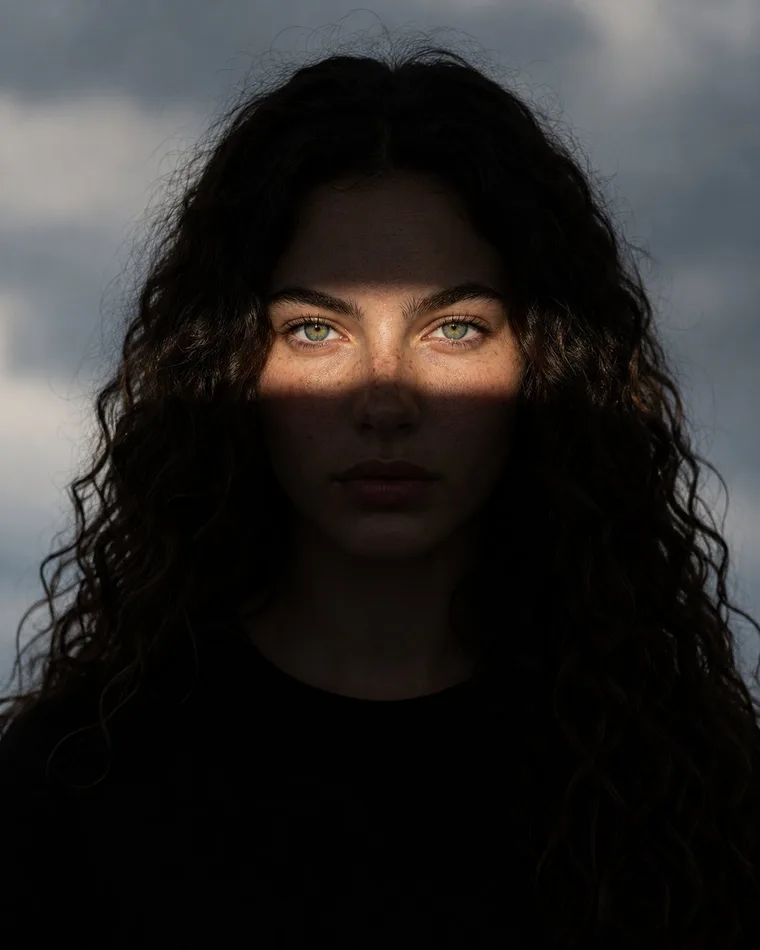
The Light Bar

One narrow beam across the eyes and nothing else. Underexpose everything, expose for the strip, and let the frame do the rest.

  • 4:5 vertical
  • Single hard source
  • Full camera spec
  • Underexposed
Read the prompt

Why it works

The instruction that makes this work is counter-intuitive: expose for the illuminated region, not the face. Generators default to a well-lit, evenly rendered subject because that is what most of their training data looks like. You have to actively spend words fighting that, hence the explicit ban on fill, rim, bounce and secondary sources, and the note that the shadow edge should be slightly irregular rather than a clean graphic band.

Swap these first

narrow horizontal beam across the eyes

vertical slash, blind-slat stripes, a thin diagonal

pale blue-grey overcast sky

black void, deep red wall, distant city bokeh

matte black crew-neck

white shirt for a much higher-contrast read

The prompt

Create an ultra-photorealistic cinematic portrait of #SUBJECT attached in image 1.

The subject stands perfectly centred, facing directly toward the camera with a completely neutral expression.

COMPOSITION Vertical 4:5 portrait. Static camera. Eye-level viewpoint. Perfect bilateral symmetry. Head and shoulders composition. The subject occupies approximately 78-82% of the frame height. The top of the hair sits close to the upper edge while both shoulders remain visible near the lower corners. No tilt. No perspective distortion. No Dutch angle.

SUBJECT Replace #SUBJECT with the exact person attached while preserving every other characteristic of the image. The subject looks directly into the lens. Eyes remain perfectly level. Mouth closed. Relaxed facial muscles. No smile. No visible emotion. Natural realistic skin texture. No beauty retouching. No makeup unless specified by #SUBJECT. Hair follows the natural appearance of #SUBJECT. Wear a simple matte black crew-neck shirt with no logos, graphics, texture or branding.

LIGHTING - CRITICAL Single hard directional sunlight. The entire portrait is intentionally underexposed. Expose for the narrow illuminated region rather than the face. A very narrow horizontal beam of sunlight crosses only the eyes. The beam begins slightly above the eyebrows and finishes approximately halfway down the nose bridge. Both irises are fully illuminated. Both eyebrows receive partial illumination. The upper cheeks receive a slight amount of light. Everything above the beam falls into deep shadow. Everything below the beam falls into deep shadow. The nose, cheeks, jawline, mouth and neck remain almost completely black. Maintain a natural optical light transition. Do not create a perfectly straight graphic band. The edges of the shadow should be slightly irregular as though real sunlight is passing through a narrow opening. No fill light. No rim light. No bounce light. No secondary light source. No catchlights except those naturally created by the sunlight.

EXPOSURE High contrast. Deep blacks. Preserve highlight detail in the illuminated strip. Natural skin reflectance. No clipped whites. Minimal dynamic range compression. Rich shadow density.

BACKGROUND Simple overcast pale blue-grey sky. Soft cloud texture. Completely out of focus. No horizon. No buildings. No landscape. No trees. No objects. No gradients added in post.

COLOUR Muted cinematic grading. Cool blue-grey background. Neutral skin tones. Very restrained saturation. Natural white balance. No teal-orange grading. No excessive colour separation.

CAMERA Full-frame professional mirrorless camera. 85 mm portrait lens. f/4. ISO 100. 1/1600 s. Extremely sharp eyes. Natural depth of field. No artificial blur.

RENDERING True photorealism. Natural pores. Real facial texture. Subtle eyebrow hairs. Natural eyelashes. Fine hair detail. No CGI appearance. No stylisation. No painterly effects. No HDR look. No excessive sharpening. No skin smoothing. Editorial portrait photography quality. Ultra-high-resolution 8K.

NEGATIVE PROMPT No smile. No side lighting. No studio lighting. No softbox. No rim light. No lens flare. No glow. No bloom. No makeup enhancement. No beauty filter. No text. No watermark. No jewellery. No accessories. No hat. No logos. No facial distortion. No asymmetrical eyes. No exaggerated facial features. No low-resolution textures. No digital painting. No anime. No illustration. No stylisation. No additional people. No background objects.

07Interface render

The Product Hero

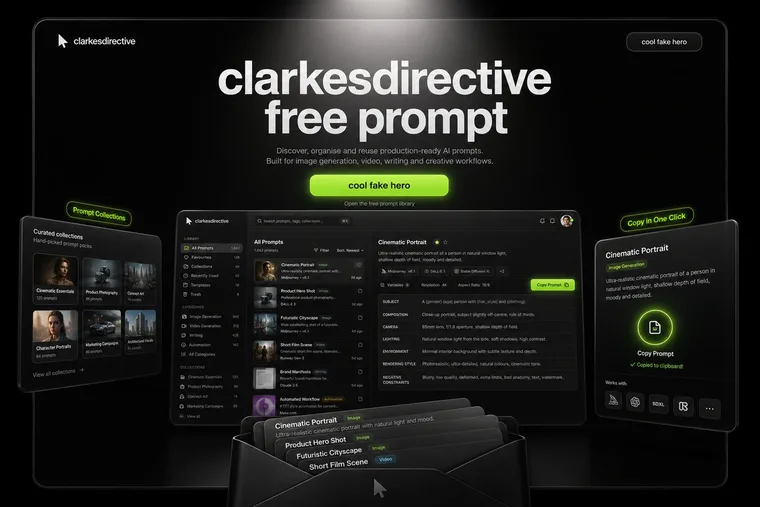
Proof the method travels. Same discipline, no human subject: an entire software landing page rendered as a single image.

  • 3:2 landscape
  • Interface
  • Named regions
  • No subject needed
Read the prompt

Why it works

Identical architecture to the portraits, pointed at an interface instead of a face. Composition, lighting, colour, rendering, exclusions. The specificity is what keeps the type legible and the panels aligned: named regions, named UI elements, a named colour palette, and a closing lock that forbids the model from rearranging the layout it was just given.

This is a generated image, not a screenshot. The interface in it does not exist, the placeholder text in the buttons was never replaced, and the numbers on the panels are whatever the model invented. That is the point: it is the output of the prompt below.

Swap these first

neon lime-green accents

electric blue, warm amber, monochrome white

prompt library dashboard

analytics suite, CRM, video editor, booking platform

16:9 landscape

4:5 for social, 3:2 for a press kit

The prompt

Ultra-premium AI prompt library SaaS landing page hero for a platform called {argument name="brand" default="your brand"}. Deep obsidian-black interface with cinematic spotlight lighting, floating glassmorphism UI panels, and luxury creative software aesthetics. Inspired by Apple product launches, Linear, Arc Browser, and high-end AI startup branding.

Use a perfectly centred and symmetrical composition with a large rounded-corner application frame floating on a pure black background. Maintain precise framing, visual hierarchy, object placement, symmetry, perspective, lighting structure, and spacing throughout.

Top-left: minimal monochrome directive-arrow or prompt-cursor logo beside the lowercase wordmark {argument name="brand" default="your brand"}. Top-right: floating glassmorphism button.

Hero section: massive oversized bold white typography centred. Typography is ultra-clean Swiss-style sans-serif with tight leading, monumental scale, and subtle light reflections passing across the letters. Below headline: small muted-grey supporting copy. Centred beneath: large glowing neon-green CTA button. Tiny microcopy underneath.

Lighting: a focused white spotlight descends from the top centre of the frame, creating a soft cone of illumination over the headline and CTA. The light gradually fades into darkness toward the edges, producing a luxury stage-like presentation.

Main showcase section: large floating AI prompt-library dashboard interface positioned below the CTA. Dashboard includes dark glassmorphism panels, a searchable prompt library, a large prompt-preview workspace, prompt title, description and category, folders and curated collections, image, video, writing and automation categories, model compatibility labels, variable and placeholder fields, a copy-prompt button, save and favourite controls, recently used prompts, a navigation sidebar, subtle green status indicators, soft internal shadows and premium creative-tool UI styling.

The central prompt editor displays a structured production-ready prompt with clearly separated sections such as: subject, composition, camera, lighting, environment, rendering style, negative constraints.

Foreground: large partially opened matte-black prompt card holder emerging from the bottom centre of the composition. Several layered prompt cards are visible inside it, creating a physical metaphor for a curated prompt archive while preserving the exact size, position, silhouette and foreground depth of the envelope element.

Left side: floating angled dashboard card emerging from darkness with a glowing pill label. The card displays a compact grid of curated prompt thumbnails, folders and category tags. Right side: floating angled dashboard card emerging from darkness with a glowing pill label. The card displays a selected prompt, a prominent copy icon and small model-format indicators. Side cards remain tilted in perspective and softly blurred to reinforce depth hierarchy.

Design language combines: Apple keynote aesthetics, cinematic SaaS presentation, premium AI prompt tooling, dark luxury minimalism, glassmorphism, Swiss typography, high-end creator software, structured prompt engineering, futuristic creative productivity, subtle cyber-minimalism.

Rendering style: front-facing website hero screenshot, ultra-clean alignment, realistic UI rendering, highly legible interface text, HDR bloom, soft volumetric spotlight, subtle film grain, ambient occlusion, realistic glass reflections, Octane Render-quality lighting.

Colour palette: obsidian black, graphite grey, soft white typography, muted charcoal, neon lime-green accents.

16:9 aspect ratio, ultra-premium prompt-library SaaS landing page render, photorealistic AI software marketing aesthetic, high-end Framer or Webflow showcase quality.

Do not change the composition. Do not move, remove or resize any major visual element. Only use the specified branding, copy, dashboard content, labels and foreground metaphor.

The pattern

Read three of them and you will start to see the skeleton.

Same architecture every time. Identity locks, then composition, then pose, then wardrobe, then environment, then light, then camera, then rendering, then a list of things the model is forbidden to do.

That skeleton is the actual asset. The words hanging off it are interchangeable, which is why a useful library is not a pile of prompts. It is one architecture applied over and over across portraiture, product, concept art, video and copy.

Fair questions

The objections I would raise myself.

Why give these away?

Because the fastest way to explain what a well-built prompt is worth is to hand you seven and let the results do the arguing. If they save you an afternoon, you will have a reasonable idea of what a working library saves in a week. That is the entire pitch, and there is no step between reading this and using them.

Did you write all of these yourself?

No, and I would rather say so. These are handpicked. Some are mine, some I found and rebuilt until they produced the same result twice, and all of them I reworked to run on a placeholder instead of one fixed subject. What I can tell you is that every image on this page came out of the prompt printed beside it, generated by me in GPT, using my own character.

Will they stop working when the models change?

Individual lines will. The architecture will not. Identity locks, labelled blocks and negative constraints have survived every model generation so far. When a specific prompt degrades, the fix is to revise the block that broke rather than throw the whole thing out.

I write my own prompts.

Then you will get more out of these than most people, because you will read them structurally rather than copy them. The value was never that you cannot write one. It is that you should not have to write the same one for the fourth time.

Can I use the outputs commercially?

Your outputs, yes. Client work, your own brand, paid campaigns, resale of the images you generate. Check your generator's licence terms as well, since those are set by the model provider rather than by me. My images are a separate matter: the frames on this page are my own character and they stay mine, so please do not repost or redistribute them. Take the prompt, run your own subject.

Will there be more?

Yes. This page is built to grow, and new prompts get added here rather than dripped out behind a signup. If you want to know when, the build notes go out on Instagram.

What this is part of

The hard part was never writing the prompt.

It is the twenty minutes you lose every time you need one and start from a blank box. Then the second twenty, when you cannot find the version that worked last month. Then the third, explaining to someone else why their output does not match yours.

That is the problem I am building Transora to solve. Not a bigger pile of prompts, but a place where the one you need is already tested, already labelled with the models it holds up on, and already parameterised so you can change the outfit without breaking the lighting.

These seven, the fifty style transfers, and the character-swap library are the beginning of what goes in it. On 28 August they stop being a page you read and become a shelf you pull from. The first fifty in get early access and a price locked for good.